You made your first sales. The dashboard shows a number you’re proud of. Then you go to withdraw it and find a smaller figure, a date a week away, or a button that’s greyed out.
That’s usually when the panic sets in.
Usually nothing is wrong. Payouts follow rules that most platforms explain badly. This guide walks through how the #money gets from a buyer’s card to your account, where it slows down, and what it costs along the way, so you can plan around it. This guide explains how feet pic payouts work, when your earnings become available, and which fees can reduce the amount you receive.
“Earned” vs “withdrawable”: how pending and available balances work
Most creator dashboards show at least two numbers, and they are not the same thing.
- Pending (or earned) balance: money from sales that went through but hasn’t cleared yet. It’s yours on paper, but you can’t move it.
- Available (or withdrawable) balance: money that has cleared the platform’s hold and can be sent to your #payout method.
Some platforms add a third state, such as “processing” or “in transit,” for money you’ve already requested but that hasn’t reached your account.
When you plan your month, the available balance is the only one that counts. If a big week shows up as pending, treat it as money arriving later, not money you have now. If a number looks wrong after a busy stretch, screenshot it and contact support the same day.
Holding periods: why they exist and why the first payout is slowest
A holding period is the time between a buyer paying and that money becoming available to you. It can feel like the platform is sitting on your cash, but there’s a reason for it.
Card payments can be disputed or reversed for a while after the purchase. Stolen cards, chargebacks and “I didn’t authorize this” claims often land in the first days or weeks, and the hold gives the platform time to catch many of them before money leaves. It doesn’t end the risk, though. Disputes can still arrive after funds become available or have already been paid out, and how any deduction or recovery is handled depends on each platform’s terms.
Holds often run from a few days to a couple of weeks, depending on the platform, the payment type and your account history. Your first payout is usually the slowest, because it often triggers extra checks: identity verification, confirming your payout details, and sometimes a manual review. Later payouts tend to move faster once your account has a clean record.
The practical fix is a cash buffer. Don’t launch counting on your first earnings to cover rent that week. If you can, keep enough set aside to cover a few weeks of essentials, so a slow first payout is an annoyance rather than an emergency.
It also helps to know what a normal delay looks like, because scammers lean on payout confusion. A buyer who sends a “payment pending” screenshot and asks you to deliver first, or to refund an “overpayment,” is not dealing with a holding period. FeetRecords has a separate guide on how to spot fake payment proof and other common seller scams that’s worth reading alongside this one.
Minimum thresholds and payout schedules
Most platforms won’t send a withdrawal until your available balance passes a minimum. On top of that, many pay on a schedule (weekly, twice a month or monthly) rather than whenever you ask.
Put those together and your early income can feel lumpy. A few small sales may sit under the minimum for weeks. Then one good week pushes you over, but the next payout date is still days away. Neither rule is a red flag on its own. They just mean the first month’s cash flow rarely matches the sales.
Low minimums are friendlier to new creators. Higher ones push you to save whether you want to or not. To see how these rules differ between sites, Daily Crave Hive’s comparison of OnlyFans alternatives lines up creator platforms side by side and also covers their fees and payout rules.
Before you launch, write down three things from your own dashboard and terms:
- The minimum withdrawal amount
- How long the hold lasts before funds become available
- The payout schedule, and whether you can request a payout manually
These change, so check them yourself.
Payout methods compared
Once money is available, how you take it out affects speed, cost and privacy. Options vary by platform and country, but they usually fall into four groups.
Bank transfer
- Speed: usually a few business days, sometimes longer for international transfers.
- Fees: often low or free for domestic transfers, higher across borders.
- Privacy: the platform or its payment processor appears as the sender.
- Availability: widest, though not every country is supported.
E-wallets
- Speed: often faster than bank transfer to reach the wallet, but moving money from the wallet to your bank adds another step.
- Fees: there may be fees to receive, convert or withdraw.
- Privacy: adds a layer between the platform and your bank, which can help separate transactions, but it doesn’t guarantee anonymity. Providers may still require ID verification, so confirm yours permits your type of creator business.
- Availability: depends on which wallets the platform supports in your region.
Instant payouts
- Speed: minutes to hours, usually to an eligible debit card or account.
- Fees: typically a percentage or flat fee per withdrawal.
- Best for: emergencies, not routine use.
Crypto
- Speed: can be fast once the platform processes the request.
- Fees: network fees, plus exchange fees when you convert to regular currency.
- Risks: price swings between payout and conversion, transactions that can’t be reversed if you enter the wrong address, and more record-keeping at tax time.
- Availability: offered on some platforms and not others, and local rules vary.
There’s no single best method. Many creators use bank transfer as the default and keep a faster option for when timing matters.
Hidden costs: conversion, international transfer and instant-payout fees
The platform’s commission is the fee everyone talks about. The smaller costs after it are easier to miss.
- Currency conversion: if you earn in one currency and your bank uses another, someone converts it, and the rate often includes a margin on top of the market rate.
- International transfer fees: your bank, an intermediary bank or the platform may each take a cut on cross-border payouts.
- Instant-payout fees: paying for speed every week adds up quickly.
- Wallet withdrawal fees: moving money from an e-wallet to your bank can carry its own fee.
Illustrative example (not any platform’s real rates): $100 in sales, minus a 20% commission ($20) and a $2 payout fee, leaves $78, before any currency conversion costs.
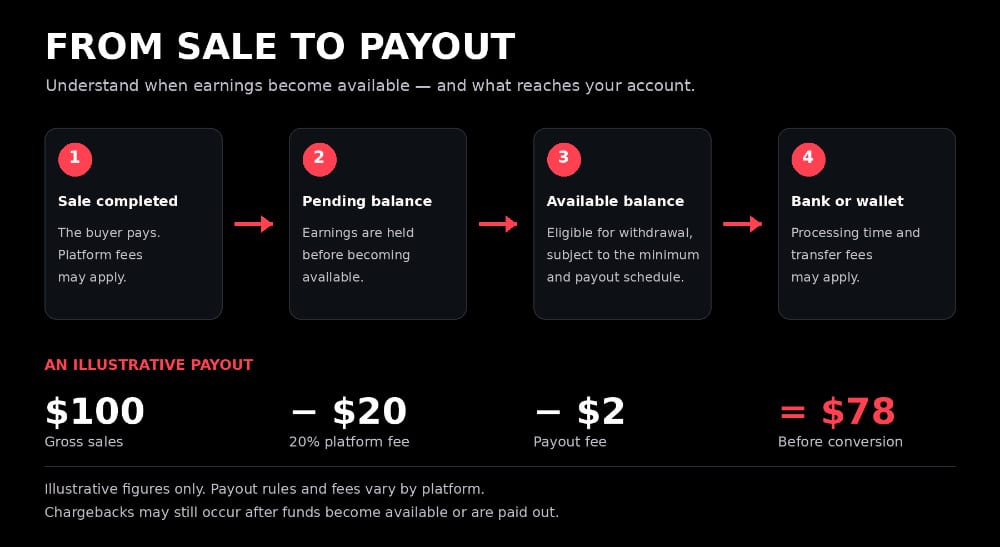
None of these looks big on its own, but together they can take a noticeable bite out of each payout. When you work out how much to charge for foot pictures, base it on what actually reaches your bank, not the sale price. A quick test: payouts often combine several sales, so rather than tracing one sale, compare a payout statement with the matching bank deposit. Any gap shows what transfer and conversion are really costing you.
Payout privacy: what shows on bank statements
Many #creators want their income kept private from family, housemates or a partner who shares a banking app. Here’s what to know.
The name on a deposit is usually the platform’s legal company name or its payment processor’s, and not always the brand name you know. Some use neutral descriptors and some don’t. If this matters to you, check the platform’s help pages or support before your first withdrawal, rather than finding out from a shared statement.
Some simple ways to keep creator income separate:
- Open a separate bank account just for creator payouts.
- Use an e-wallet as a buffer between the platform and your main bank. It can help separate transactions but doesn’t guarantee anonymity: providers may still require ID verification, so confirm yours permits your type of creator business.
- Use a dedicated email address for your payout and platform accounts.
- Turn off banking app notifications on shared devices.
Keeping income separate also makes taxes and budgeting much easier.
A pre-launch payout checklist and record-keeping tips
Run through this before you announce anything:
- ☐ Identity verification completed and approved
- ☐ Payout method added and confirmed with your legal name
- ☐ Minimum withdrawal, hold period and schedule written down
- ☐ Fees for your chosen method checked, including conversion
- ☐ Bank statement descriptor checked if privacy matters
- ☐ A cash buffer that covers the first few weeks
- ☐ A separate account or wallet for creator income
Records don’t need to be fancy. A simple spreadsheet works:
- Date of each payout, amount requested and amount received
- Fees deducted and the method used
- Monthly totals for gross sales vs money received
- Screenshots of dashboard balances before each withdrawal
Keep payout statements in one folder. If a payout goes missing, or tax season arrives, you’ll be glad you did.
Conclusion
Payout delays are mostly predictable once you know how they work. Learn your platform’s minimum, hold period and schedule, pick a payout method with your eyes open about fees, keep a buffer, and keep records from day one. Then the first withdrawal is just a date on your calendar.